From electric taxis to a stuck solar battery: how Anne Clara Laugesen found her way to Photoncycle
Every Danish home with solar panels eventually hits the same wall: plenty of power in summer, not enough in winter. Anne Clara Laugesen, now Photoncycle's General Manager in Denmark, ran into that exact problem in her own garden years before she ever led the company's Danish rollout. Her path there ran through electric taxis, EV chargers, and one uncomfortable carbon calculation along the way.
Long before Anne Clara Laugesen became Photoncycle's General Manager in Denmark, she was, by most measures, doing everything right. She biked to work every day, and had been a pescatarian for years. She thought of herself, in her own words, as "a climate-conscious person, not only in my career, but also in my personal life."
Then, in 2019, she sat down and ran her own life through a handful of online CO2 calculators, just to see where she actually stood. Those calculators put the average Dane's personal footprint at around 17 tons of CO2 that year. Anne Clara's own number came out to 23.
"I was like, I'm actually worse than the average Danish person," she says. "What causes this discrepancy?"
The answer was flying. The startup's Danish division reported to headquarters in the Netherlands, so she was commuting back and forth by plane. She had told herself the job cancelled out the cost: as she was building something good for the climate, so the flights felt justified. The math said otherwise. Half her emissions came from air travel alone, so she gave herself a challenge: no flying for a year.
"I realized it's actually not that difficult to not fly as much," she says. She's flown twice since. "The single largest emitting decision you can make as a consumer is to take a flight," she says. "We're not going to stop flying. But if more people reduce how often they do it, that's a good thing."
From Peru to electric taxis in Copenhagen
That moment of doing the math on herself sits alongside an earlier one. Fresh out of high school, Anne Clara went to Peru to volunteer at a center for children with special needs, convinced, as she puts it, "naively," that she could go out and save the world. She came back with a slightly calibrated thought: "I figured out I cannot save the world, at least not by myself, but I can make a difference for a few little kids." That gap, between the scale she'd hoped for and what one person volunteering can actually move, is what stayed with her: a bigger impact meant working at a more structural level, where one decision moves things for a lot of people, not just a few.
She carried that into her career. After a short stint in Tel Aviv's startup scene, she came back and spent most of her career in Copenhagen, increasingly focused on electrification. She was part of the team at Viggo, that launched Europe’s first fully electric ride-hailing service, working on it from before launch through to exit, and helped put 350 electric taxis on Danish roads. For a stretch, that gave Copenhagen the highest share of EVs in any taxi fleet in Europe, until Oslo's municipality made it law that taxis had to be 100% electric. She also worked on building out EV charging infrastructure at Stella, the unglamorous plumbing that makes electric vehicles viable for ordinary drivers and businesses.
Where the personal and the professional collided
Somewhere in the middle of all that, the structural work came home, literally. Anne Clara put solar panels, a battery inverter, and a heat pump on her own house, swapping out her gas boiler.
"Electrification is great," she says, "but it also comes with certain challenges." Watching her own solar production, she kept running into the same wall: even with a home battery attached, she could use less than half of what her panels actually produced. Denmark makes plenty of solar power in summer. It needs the power in winter. Nothing in her home setup could move energy from one season to the other.
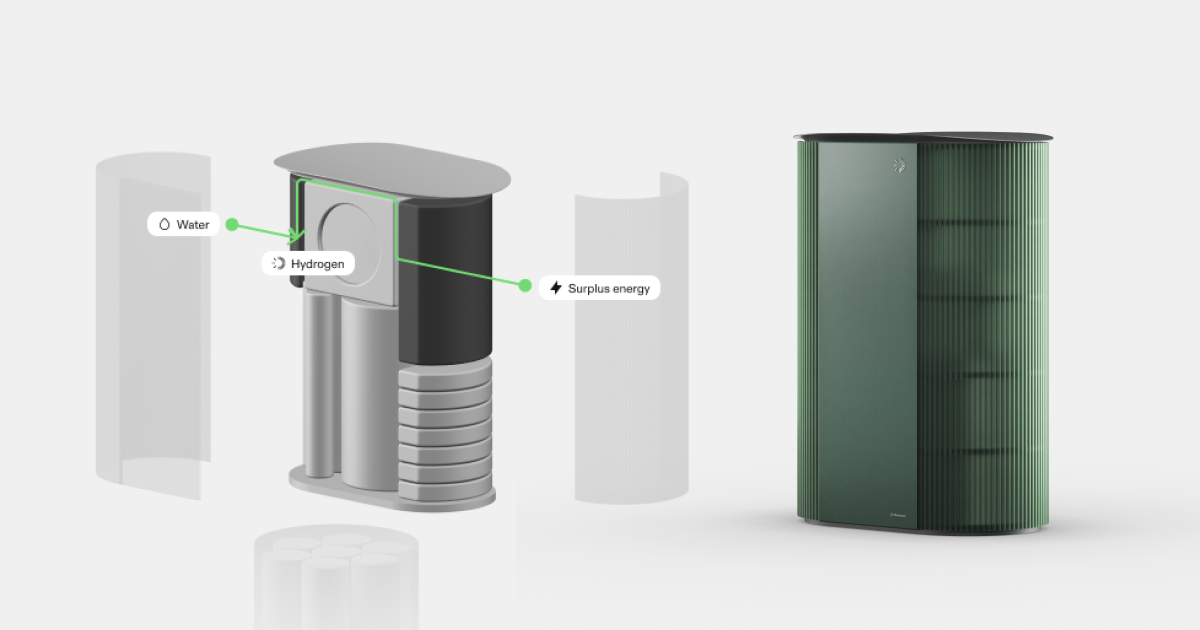
That gap, not a lack of renewable power but a mismatch in timing, is precisely what Photoncycle is built to close. Anne Clara found the company while looking for an answer to a problem she already had, in her own garden. It's how she ended up leading the Danish side of the business: not a career pivot into climate work, but the continuation of one she'd been on for years, now aimed at the exact wall she'd personally hit.
Building a category that doesn't exist yet
Running the Danish rollout comes with a particular kind of difficulty: there's a lot of interest, from pre-order customers and from people just curious, and making sure everyone gets a thoughtful answer takes time. The questions range widely. One person wrote in asking whether the system could be installed in a hexagon-shaped, rotating house. "That I feel is a very specific question," Anne Clara says, "but we actually get a lot of those."
The bigger challenge sits underneath the day-to-day one. "What we're building doesn't exist," she says. "We don't really fit into most societal boxes. We need to create our own box to fit in society in general." Nobody has done seasonal storage at a household level before, which means there's no existing playbook to follow, no standard permitting category, no established installer network to plug into. "It's hard," she says, "but it's also really rewarding, because it allows you to be creative, to think outside the box, because there's no box to actually think in."
One of the more pleasant surprises has been the team itself. Photoncycle is a deep-tech company staffed largely by specialists, people who know one narrow, technical thing extremely well, which might sometimes come with a rigid way of thinking. "What I really admire with all my colleagues," she says, "is that everybody seems to have this very flexible mindset. If you ask a question or you challenge something, you're not met with a no. You're met with a 'hmm, that's an interesting perspective, let's look at this.'"
A trip to Oslo, taken slowly
The team is spread across cities, with the Danish side largely remote from Photoncycle's base in Oslo, which makes the in-person time count for more when it happens. Anne Clara took the train there, as she does most places now: Copenhagen to Oslo, through Sweden, with lakes and mountains out the window most of the way.
"It's a slow travel way of having a mindset that things don't always need to go really fast," she says. Instead of losing three or four hours to an airport, a possible delay, and the general rush of flying, "you just sit on a train, and seven hours later you're there," with a full day to actually work, uninterrupted, along the way.
The trip's highlight wasn't a meeting. It was walking through Photoncycle's full-scale pilot unit in person. Day to day, Anne Clara works from visualizations and data, dashboards, not hardware. Seeing the physical system running in detail, for the second time but with a far more thorough walkthrough than before, made the whole thing concrete. "That made me really excited about putting this system out in actual live Danish households," she says.
The rest of the value showed up in smaller moments, the kind that don't make it into a project plan. "It's hard to remember everybody's name when you're not sitting next to them every day," she says, "and to remember what everybody actually does." Coffee-machine conversations, she's found, tend to surface what a colleague is actually working on, and why something that looks simple from a distance is genuinely hard up close. That understanding is what makes the next stretch of remote collaboration go more smoothly.
Why it matters past one household
Ask Anne Clara to zoom out, and the answer comes back to the grid. The strain is not hypothetical. In 2026, Danish grid operator Energinet paused new large-scale connection agreements after a surge in capacity requests, most of it driven by data centers and other large-scale consumers, on top of the broader shift to electric vehicles and heat pumps. The surge far outstripped what the network could absorb. It's the sharp edge of a broader pattern: electrification in Denmark is accelerating faster than the grid built to carry it, and the distribution network's investment needs are projected to climb sharply over the coming decade as a result.
Anne Clara's view is that distributed, household-level storage is one piece of easing that pressure, not a fix on its own, but a meaningful one. A home generating and using more of its own renewable energy year-round, rather than drawing from and pushing back onto the grid at peak moments, is a home that asks less of an already-strained network. "This is the larger mission that I really tie into here," she says: a system that pays off for the individual household, eases pressure on the grid it sits on, and reduces a country's exposure to gas and fuel it has to import.
For now, the work ahead is less abstract: building the onboarding flow and the customer journey from the ground up, how installation actually works, which partners are needed, which permits apply, in close contact with the homeowners who'll be first through the door. It's the same instinct that sent her digging into her own carbon footprint years ago, and the one that had her standing in a pilot unit in Oslo, following the numbers to the people who'll actually live with the result.
Anne Clara Laugesen
- Background in tech and startups, spanning Copenhagen, Berlin and Tel Aviv
- Previously part of the Viggo team behind a fully electric ride-hailing service in Copenhagen, from pre-launch to exit
- Converted her own home to solar, battery, and heat pump before joining Photoncycle
- Now leads Photoncycle's rollout to Danish households
Want to be one of the first Danish households to bring this home?